UPI's Record October 2026: ₹31.5 Lakh Crore, Merchant Charges Coming & What Small Businesses Must Do
UPI crossed ₹30 lakh crore in October 2026 — its biggest month ever. Merchant charges up to 0.4% are coming for payments above ₹2,000, likely from 1 January 2027. What Indian small businesses must know.
 CodeFree Team
November 16, 2026
10 min read
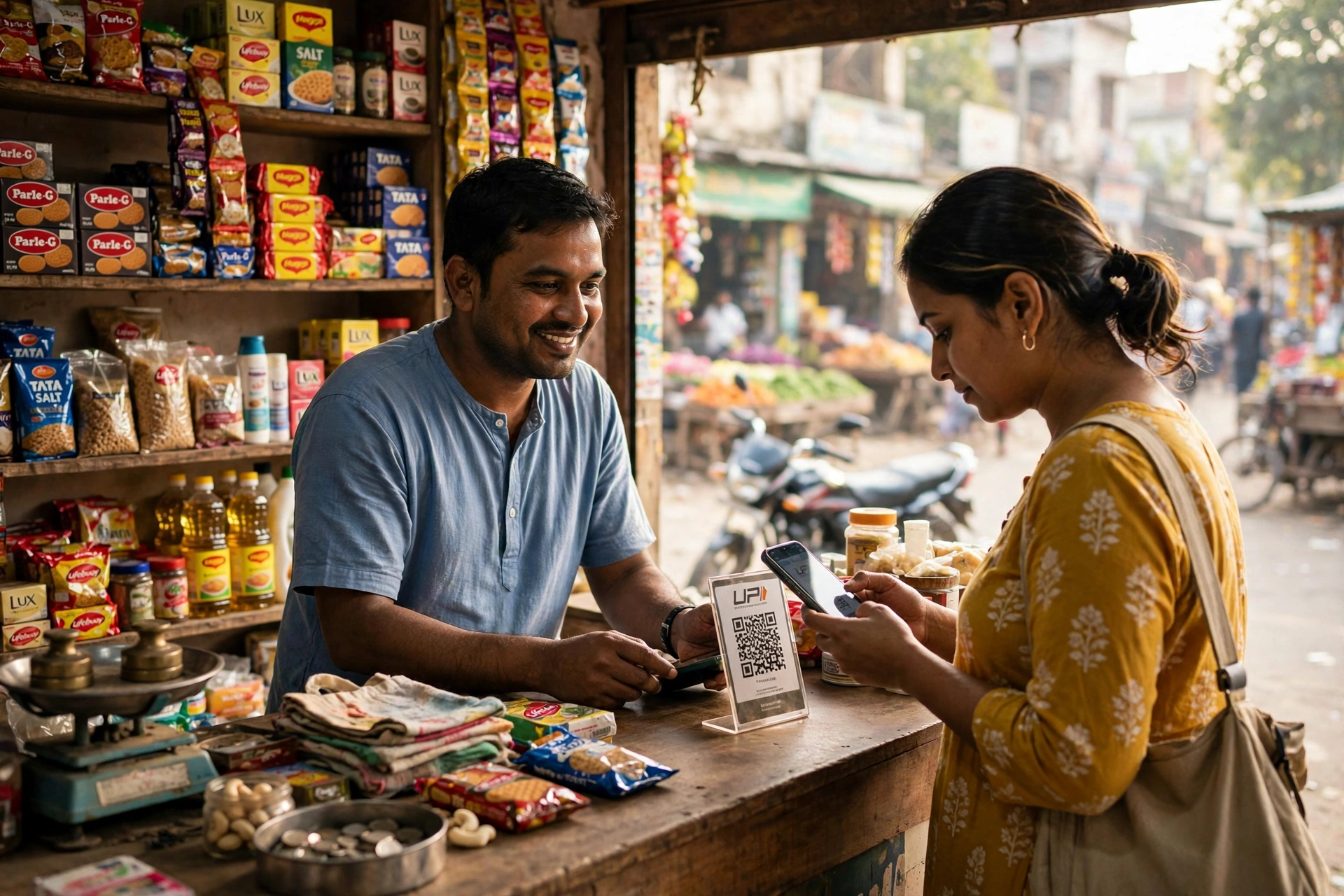
October 2026 was the biggest month in UPI's history — and it arrived in the same week that the question every Indian shopkeeper has been asking finally got an answer in court. UPI processed 25.47 billion transactions worth ₹31.53 lakh crore in a single month, the first time the monthly value has crossed ₹30 lakh crore. Average daily value crossed ₹1 lakh crore for the first time too, on roughly 821 million transactions a day.
But the record month came with a bill attached. The National Payments Corporation of India (NPCI) has confirmed the shape of merchant charges on UPI — and while your customer's ₹100 chai payment stays free, larger merchant payments are heading toward a fee. Add in a brand-new NPCI subsidiary chasing AI and blockchain, a quality warning hidden inside the record numbers, and a new scheme to take UPI deeper into small towns, and October 2026 turns out to be one of the most consequential months in Indian payments since UPI launched.
Here is what actually happened, what it costs a small business in real rupees, and what you should do before the charges switch on.
1. The Record: UPI's Biggest Month Ever
The numbers, first reported from NPCI data in early November, are worth reading slowly:
- 25.47 billion transactions in October 2026 — up about 23% year-on-year.
- ₹31.53 lakh crore in value — up about 16% year-on-year, and the first month ever above ₹30 lakh crore. The previous monthly value record was ₹29.9 lakh crore in May 2026.
- Average of 821 million transactions a day, with average daily value topping ₹1 lakh crore for the first time.
- 758 banks live on UPI.
For context, that is roughly 9–10 transactions a month for every Indian — and it happened in a festival month, with Diwali falling on 8 November 2026 and October carrying the full Dhanteras and pre-Diwali shopping rush. UPI is no longer a payments option in India. For most small businesses, it is the cash register.
The record also matters because it strengthens NPCI's hand in the argument that follows: a system this large, this free for users, needs someone to pay for the rails.
2. Merchant Charges Are Coming — But Not on Every Payment
The most misunderstood fact about UPI charges is that they are not a tax on every scan. Here is the framework NPCI defended in a roughly hundred-page affidavit filed in the Supreme Court on 3 November 2026, in the public interest litigation challenging the merchant discount rate (MDR) framework:
- Person-to-person (P2P) payments stay free. Sending money to a friend or family member costs nothing, and nothing in the framework changes that.
- Person-to-merchant (P2M) payments up to ₹2,000 stay free. The government has confirmed that payments of ₹2,000 or less at a shop attract no charge. That covers the overwhelming majority of everyday transactions at kirana stores, tea stalls, salons and street vendors.
- Above ₹2,000, merchants may be charged up to 0.4%, capped at ₹300 per transaction. A ₹5,000 payment would attract at most ₹20; a ₹1,00,000 payment would attract ₹300, not ₹400, because of the cap.
- Only about 4% of merchant payment volume sits above the ₹2,000 line, by NPCI's own figures — which is why the framework is being presented as a charge on larger-value commerce, not on the neighbourhood shop.
One date to circle: the go-live itself is still not formally notified. NPCI's October position was "immediately after Diwali"; with Diwali now past, reporting in the Financial Express points to 1 January 2027 as the likely start. Treat that as the working date, not a promise — watch NPCI's circulars, not forwards.
 3. What MDR Actually Costs a Small Shop — in Real Rupees
Percentages hide the real impact, so here is the arithmetic for a typical small business:
- Kirana store, average ticket ₹350: zero. Every payment is below ₹2,000, so no MDR at all.
- Electronics shop, average ticket ₹5,000: ₹20 per transaction at 0.4%. On 100 such sales a month, that is ₹2,000 a month — real money, but roughly the cost of one day's electricity.
- Furniture or jewellery shop, ₹50,000 ticket: ₹200 per transaction. On 20 such sales, ₹4,000 a month.
- Any single transaction above ₹75,000: the ₹300 cap kicks in, so the effective rate falls below 0.4%.
Three practical points follow. First, the charge lands on the merchant, not the customer — you cannot legally pass it on as a UPI surcharge, so build it into pricing the way you already build in card-machine fees. Second, compare honestly: a credit-card MDR of 1.5–2% is four to five times higher, so UPI remains the cheapest digital rail by a wide margin. Third, the ₹2,000 line creates a visible incentive to keep small tickets on UPI and to think about pricing on large ones — but splitting a ₹4,000 bill into two ₹2,000 scans to dodge the fee is exactly the kind of behaviour banks' risk systems flag, so don't.
4. NPCI's Next Move: A New Subsidiary for AI and Blockchain
On 4 November 2026, NPCI announced NPCI Tech Solutions Limited (NTSL), its fourth wholly owned subsidiary after NPCI International Payments, NPCI Bharat BillPay and NPCI BHIM Services. The mandate is deliberately wider than payments: artificial intelligence, blockchain, digital financial infrastructure and global capability centre (GCC) services, plus technology work for India's digital public infrastructure programmes such as eKYC Setu and the Unified Ticketing Platform.
NPCI's chief technology officer Vishal Kanvaty, with the organisation for nearly a decade, moves over as NTSL's managing director and CEO. The AI work is not starting from zero: NPCI has already built FiMI, a domain-specific language model for India's payments ecosystem, and an AI-powered UPI Help Assistant for transaction queries, grievance redressal and mandate management. It has also partnered with Nvidia to build AI capabilities for the payments ecosystem, with applications for banks and fintech companies.
Why should a small business care? Because this is the pipeline that decides what UPI looks like in 2027–28: smarter fraud detection, faster grievance resolution, AI help when a payment fails, and possibly blockchain-based settlement rails that make merchant payouts faster. The same week also saw NPCI launch UPI One World for foreign guests at the India AI Impact Summit in New Delhi — visitors can load a wallet with an international card and pay at any standard UPI QR code. If your shop sits near a tourist spot, an airport or a conference venue, that is new footfall you can accept with the QR code you already have.
 5. The Warning Inside the Record: Failed Payments Are Creeping Up
Buried in the celebration is a number merchants should not ignore. NPCI's September 2026 data shows technical decline rates among the 20 largest remitter banks rising to 0.24%, up from 0.18% in August. The worst performers were far above the average: ICICI at 0.73%, SBI at 0.38% and Kotak at 0.36% — all more than doubling month-on-month.
A failed UPI payment at your counter is not a statistic. It is a customer standing there while you both stare at a spinning screen, a sale that may walk away, and a "payment deducted but not received" complaint that eats your afternoon. A few habits reduce the damage: keep a second bank account linked as a fallback on your QR, use a soundbox so you hear the confirmation instead of relying on the customer's screen, and reconcile your settlement at the end of every day — a failed payment discovered at 9 pm is much harder to fix than one caught at 9 am. The regulator and CERT-In also warned banks in early November that agentic-AI attacks are now targeting payment APIs and automated disbursement systems, with individual fraud cases running into crores — another reason to treat any "urgent refund" or "verify your QR" message with suspicion and to never share an OTP.
6. UPI Vyapaar Saksham: The Push Into Small Towns
A leaked NPCI memo reported on 13 November points to a new scheme, the UPI Vyapaar Saksham Scheme, aimed at expanding UPI acceptance and merchant onboarding in Tier 3 to Tier 6 centres, the North-Eastern states, and Jammu & Kashmir and Ladakh. The scheme is expected to run for three years from the date MDR comes into force.
Read together with the MDR framework, the logic is clear: charges on larger-value urban transactions help fund the expansion of the network into places where digital payments are still thin. For a small business in a Tier 3 town, that means more onboarding support, more acceptance infrastructure and more customers arriving with UPI as their default — the same wave that transformed Tier 1 retail five years ago, now arriving in smaller towns. If you run a shop in one of these regions and have been putting off a QR code, the next twelve months are the time to get one.
7. What Small Businesses Should Do Before 1 January 2027
Five concrete moves, in order:
1. Do nothing to your ₹2,000-and-below sales. They stay free. Keep accepting UPI exactly as you do now — it is still the cheapest way to get paid.
2. Price the 0.4% into large tickets now. If you sell items above ₹2,000, add roughly 0.4% (capped at ₹300) into your margin math, the same way you already absorb card fees. Do it in November, not in a January panic.
3. Keep clean records. MDR is a business expense, and a proper invoice trail is what lets you claim it. If you still bill on paper or in a notebook, switch to a proper GST invoice — a free invoice generator with CGST/SGST breakup takes ten minutes to set up and saves hours at filing time.
4. Harden your payment setup. Link a second bank account as a fallback, use a soundbox, reconcile daily, and train staff to never share OTPs or click "verify QR" links from unknown numbers.
5. Watch the official channel, not forwards. The 1 January 2027 date is reported, not notified. The moment NPCI issues a circular, it will be on NPCI's website and in your bank's merchant communication — that is the trigger to act, not a WhatsApp forward.
Frequently Asked Questions
Is UPI still free for customers?
Yes. Person-to-person payments are free, and merchant payments up to ₹2,000 are free. The MDR framework only touches person-to-merchant payments above ₹2,000, and the charge falls on the merchant, not the customer.
Will I pay MDR on every payment at my shop?
No. Only on merchant payments above ₹2,000, at up to 0.4% capped at ₹300 per transaction. If your average ticket is below ₹2,000 — as it is for most kirana stores, food stalls and salons — you pay nothing extra.
When do the UPI merchant charges actually start?
Not yet notified as of 16 November 2026. NPCI's position in October was "immediately after Diwali"; reporting points to 1 January 2027. Treat that as the likely date and confirm from NPCI or your bank before changing anything.
What is NPCI Tech Solutions, and why does it matter to me?
It is NPCI's new technology subsidiary, announced 4 November 2026, working on AI, blockchain and digital infrastructure for payments. For merchants, it is the pipeline behind smarter fraud detection, faster complaint resolution and possibly faster settlements — the features that will shape UPI over the next two years.
Download: Free GST Invoice Generator (PHP Billing System)
With merchant charges, settlement tracking and GST filing all getting more important, a proper invoice is no longer optional. Our free GST Invoice Generator is a ready-to-use PHP billing system for Indian businesses — CGST/SGST breakup, invoice numbering, printable invoices and customer records, free source code you can run on your own hosting. Download it free from CodeFree and pair it with your UPI QR code for a complete, paperless billing setup.
Keep reading
Google's November 2026 Android Update: 7 Changes Developers and Small Businesses Should Know
Google shipped Play services v26.44 and Play Store v54.0 in November 2026 — Wallet travel QR, digital home keys, a new developer age-range API, Family Hub and more. What changed and what Indian developers and small businesses should do.
Read article
GST Council October 2026: No Rate Cuts, But 8 Reforms Small Businesses Should Know
October 2026 GST Council meeting changed no rates — but approved 8 reforms for small businesses. What changed, what didn't, and your checklist before April 2027.
Read article
Google Core Update October 2026: What Changed for Small Sites
Google announced no core update in October 2026 — but its 1 October guidance changes on AI content, main content quality, and fake authors matter more. What changed, what didn't, and a 7-point checklist for Indian small sites.
Read article